SAMPLE: Ocean Stuff
海からはじまる、つながりの物語
Study Portal は記事の一番下にあります ↓
下記の英文を日本語で読む
夏を思うとき、そこには二つの顔があります。自由と楽しさ。そして同時に、苦しさもあります。
祝日がめぐってくれば、多くの人にとって仕事を少し離れられる時間が生まれます。それだけでも助けになります。家族のいる人にとって、いちばん大きな変化は学校が休みに入ることでしょう。生活は大きく変わります――親にとっては、少々頭の痛いことかもしれません。それでも、夏休みの宿題や勉強の時間を抱えながら、家族でプールへ行ったり、旅行を計画したり、いつもより少しだけ肩の力を抜いて過ごしたりできます。暑さはあります。けれど、時間もまた少し増えるのです。
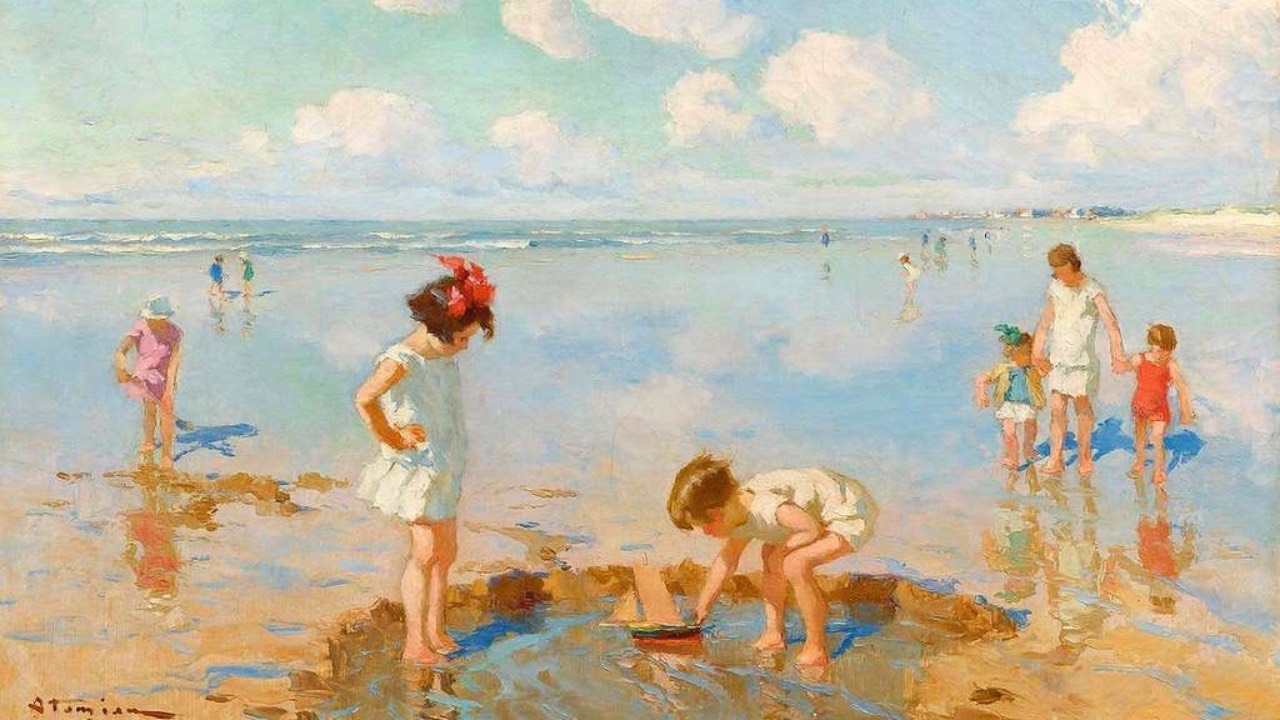
私がこの絵、By the Seaに惹かれたのも、そこでした。今から一世紀以上前の1910年、フランス系アルメニア人の画家シャルル・アタミアンによって描かれた作品です。さほど名の知られた画家ではありませんが、この光景は、今日の世界のどこかの海辺にあっても少しもおかしくありません。浅瀬で小さな帆船を試す少年。その様子を見つめる少女――妹でしょうか。それとも、たまたま通りかかった子どもでしょうか。母親は二人の幼い子どもと手をつないで歩いています。誰もが足もとへ目を落とし、生き物や貝殻を探しています。人々は自分自身を忘れ、時間の中へ溶け込んでいます。母親に帰るよう呼ばれても、子どもたちはまだいたいと駄々をこねるでしょう。日に焼けてしまったことにも気づかないままに。ばらばらに集まった人々でありながら、そこには不思議な一体感があります。皆が「今」に夢中です。私にとってこの絵は、ゆるやかな夏の日々をほとんど完璧に映し出しています。
こうした自然とのつながりから、アイスランドの歌手ビョークの曲を思い出しました。2004年、彼女はオリンピックの舞台でOceaniaを披露しました。その歌で語られるのは、人間と海とのつながりです。歌詞からは、ビョークが思い描く一体感がはっきりと伝わってきます。同じように、アタミアンの絵の背景に広がる波の下でも、ひそかに同じ世界が続いているように想像できます。
To think summer is to think twofold: freedom and fun, and yet agony.
National holidays return, giving a reprieve from work to many. That helps. For people with families, the main event is schools letting out. So life changes drastically (maybe to a parent's chagrin). Yet, despite the summer homework and study sessions, families have time to go to pools, plan trips, and just be a bit more carefree about things. There is the heat, yes; but also just more time.
That is what drew me to this painting, By the Sea. It is from well over a century ago (1910) by a rather minor French-Armenian painter, Charles Atamian, yet it could very well be a scene at any beach anywhere around the world today. It captures innocence: Note the boy testing out the sailboat in the shoal. The other girl -- could it be his sister? or just a random child passing by? -- watching. See the mother walking hand-in-hand with her two little ones. Everywhere the eyes are down: scanning, hunting for critters and shells. People have forgotten themselves. They are lost in time. You can very well imagine the children whining to stay when their mothers at last call them to go home -- blissfully unaware that the sun has given them quite the burn! It is a disparate collection of people, yet at the same time very communal; very lost in the now. And it illustrates to my mind a nearly perfect view of lazy summer days.
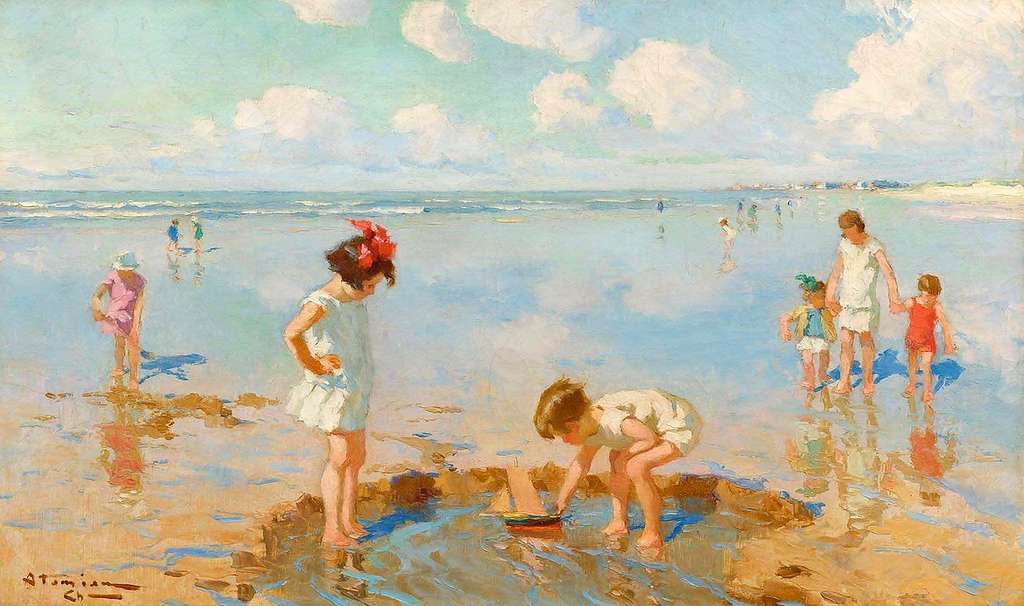 By the Sea (1910), Charles Atamian
This bit of communion with nature reminded me of a song from the Icelandic singer, Björk. In 2004, she debuted her song Oceania for the Olympics. In it, she talks of the connection between man and the ocean.
“One breadth away from Oceania, your nimble feet make prints. And sons, you have done good for yourselves, since you left my wet embrace and crawled ashore...Your sweat is salty. I am why.
From these lyrics, you can clearly understand Ms Björk's ideas of oneness. Similarly, you can very well imagine the scene being played out beneath the waves in the background of Mr Atamian's painting.
下記の英文を日本語で読む
ビョークのいう「結びつき」には、私にはどうしても、悲しみや空虚さ――ある種の憧れのようなものも感じられます。そう思うのは私だけでしょうか。私たちはつながっている。それでも、そのつながりを意識の上では感じられない。ならば、この憧れは「理解されたい」という願いなのかもしれません。人はあの「濡れた抱擁」を離れ、母なる海は悲しんでいる。互いの存在が深く結びついていることに、私たちはなんと見事なほど気づかずにいるのでしょう。そう、もしかすると、それこそがここにある感情なのです。
冒頭で触れた夏の苦しさも、そこにつながります。夏には休みがあり、日常を離れ、自由にさまよう時間があります。けれど程度の差こそあれ、私たちの内側には共通した騒がしさがあります。戻らなければならないことへの嘆き。嫌な上司や同僚への不安。「意味のない」単調な毎日。ここではないどこかのほうが、きっとましだ。そうして私たちは座り、本を読んでいるふりをしながら、本当はただぼんやりと見つめ、思考を好きなだけさまよわせます。
ここに置いたのは、1909年に芥川龍之介が詠んだ短歌です。のちに彼の憂鬱は、より臨床的な問題であったことが明らかになります。それでもこの歌は、あの「ただ見つめている」大人の心を見事に動かしています。「どこかへ逃げてしまえたなら」と、胸の内で繰り返す人の姿です。
一方、ビョークのOceaniaは、私たちは孤独ではなく、取り返しのつかない悪い場所にいるわけでもないと語ります。逃げ出すべき場所も、逃げ込むべき場所も、本当はない。私たちがそれを知ってさえいれば。1分32秒以降の歌詞には、その感覚がよく表れています。
From Ms Björk's idea of "union", I also cannot help but feel a sadness, an emptiness -- call it a longing. (Am I alone in that feeling?) Though connected, we are consciously not. So maybe this longing is the desire to be understood. Man left that "wet embrace" and Mother is sad: how marvelously clueless we all are at our interbeing -- Yes! Very well maybe that!
That agony stated at top: with summer comes breaks and time away -- freedom to wander. But common to us all (with admittedly varying degrees of intensity) is that inner cacophony: lamenting having to go back; worries over a lousy boss or lousy coworkers; your "meaningless" humdrum life. Anything is surely better! So, we sit or maybe pretend to read -- while really just staring and letting our thoughts run wild.
“青海原藻の花揺らぐ波の底に魚とし住まば悶えざらむか
This is an Akutagawa tanka from 1909. Though it eventually turned out his melancholy was of a more clinical concern, Mr Ryunosuke nonetheless perfectly animates that "just staring"; that adult repeating to himself, "if I only I could just run away!"
And it juxtaposes with Ms Björk's Oceania declaring we are not alone, we are not in a bad or poor state. There is nothing we need to run from or to. Oh, if we only knew! See the lyrics from 1:32 onward.
“You show me continents. I see islands. You count the centuries. I blink my eyes.
下記の英文を日本語で読む
この言葉は、1980年代の人気番組Cosmosでアメリカの偉大な宇宙物理学者カール・セーガンが語った思想にも響き合います。宇宙は私たちの外側にあるだけではありません。私たちは星の物質から生まれ、宇宙が自らを知るための一つの方法でもあるのです。
自分の境遇への不満とは、結局のところ、「あちら」のほうがいつも良く、「こちら」では足りないという、太古から続く考えなのでしょう。たとえば紀元前1世紀のギリシャ・ローマ世界にまで、同じぼやきを見つけることができます。オウィディウスはThe Art of Loveの中で、自分のものではないものほど魅力的に見え、他人の畑の作物や家畜のほうが豊かに思える、と語っています。
その感覚は、現代のよく知られた表現にも残っています。「隣の芝生はいつも青い」。時代が変わっても、人の心はそれほど変わらないのかもしれません。
This echoes the word of the great American astrophysicist, Carl Sagan in his very popular Cosmos series from the 1980s:
“The cosmos is within us. We are made of star-stuff. We are a way for the universe to know itself.
The dissatisfaction with our lot in life is thus the time immemorial idea that everything is just better over "there"; "this" is insufficient. It's a grumbling you can read about as far back as in 1st century BCE Greece, for example. The poet, Ovid, recites in his poem, The Art of Love:
“’tis new delights that win welcome, and what is not ours charms more than our own? In fields not ours the crops are ever more bounteous, and the neighbouring herd has richer udders.
This being echoed in the modern day turn of phrase:
“The grass is always greener on the other side.
下記の英文を日本語で読む
一枚の絵が一曲の歌へとつながり、その歌が一首の詩へ、そして古くからのことわざへと私たちを導きました。そうして最後に残るのは、人生とは「今」と折り合いをつけていくことにほかならない、という静かな理解です。私たちが育てる喜びも、痛みも、あるいは思いがけず身を置くことになる感情も――そのすべてが、まさに生きるということなのでしょう。
タルムードの言葉にあるように、「仕事を完成させることはあなたの義務ではない。けれど、それを放棄する自由があるわけでもない」。すべてを成し遂げる必要はない。それでも、今ここにあるものへ向き合うことからは逃れられません。
A painting leads to a song; leads to a poem that leads to an age-old adage, settling us calmly in the knowledge that life is nothing save a coming to terms with now. And that whatever joy, whatever pain, whatever sense of being we may cultivate or simply find ourselves in -- That is the point! As declared in the holy Talmud:
“It is not your duty to finish the work, but neither are you at liberty to neglect it.
下記の英文を日本語で読む
海を描いたのはアタミアンだけではありません。このビョークとセーガンに通じる一体感に、あなたならどの作品を重ねるでしょうか。坂上アキのスタジオと、海洋環境団体PangeaSeedが示す、それぞれ異なる視点もぜひご覧ください。
最後に、Open Libraryで公開されているThe Art of Loveを置いておきます。オウィディウスが語る、尽きることのない心の落ち着かなさに触れた箇所は37ページです。
皆さまに、何よりもよい時間が訪れますように。
― Derek
Mr Atamain is not alone in capturing the sea. What work best aligns in your mind with this Björk/Sagan sense of oneness? View different perspectives from the studio of Aki Sakagami and with the organization PangeaSeed.
Here is The Art of Love from the Open Library. You can find the reference to Ovid's endless dis-ease on page 37.
Wishing you nothing but the finest,
-Derek
Categories
Recent Posts
Author

Mr. Derek
編集者