春と若さ、そのはかなさを読む英語ガイド
Spring, Youth, and Ephemerality — A Vocabulary Guide
1. Set the Stage
Touch Here for English
Spring is now giving way toward early summer throughout most of Japan—late spring, one could say. But in the northern stretches, the blossoms are at their peak, and soon the apple blossoms begin to unfurl in all their glory.
In this context, let us take this image from Millais, one of the Pre-Raphaelite Brotherhood, who strove to move art toward the clarity and imagery of early Renaissance styles. Here, there is a distinctly Western sense of what constitutes a spring image, but also one loaded with meaning beyond simple nature.
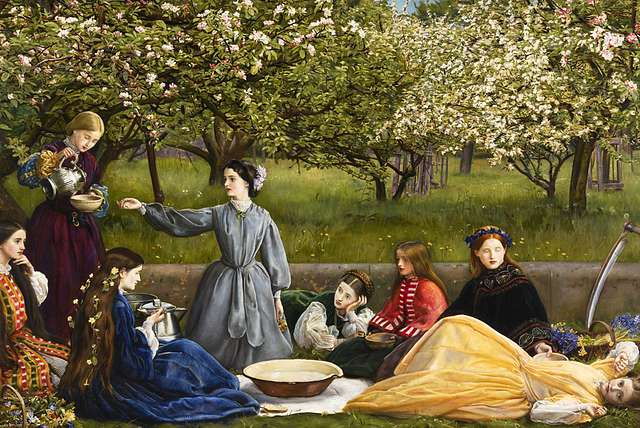
Spring (Apple Blossoms) (c.1856 - 1859), John Everett Millais
There is no language guide for this piece. Instead, there are seventeen words and nine grammar notes useful for the dissection of a painting such as this, and for the richer description of nature. Words for what you see (orchard and foreground), for how it appears (luminous and idyllic), and for what it suggests (transience and mortality).
At the same time, this is also a chance to work with structure: In the foreground…, The figure appears…, The scene suggests…, While the image feels idyllic, it also…. These small patterns allow you to build from description into meaning with control.
Explore also the symbolism embedded in the scene, as it is more than a typical fall of light through leaves—the kind that often begins and ends conversations on a Monet landscape, for example. Here, blossoms may point to youth; something as simple as a gesture or a gaze may hint at transience or mortality.
To take this further, a selection of native materials has been prepared—authoritative texts and visual resources that show how this language is actually used. After working through the vocabulary here, move outward to those sources and notice how it all comes together in real contexts.
ほぼ日本では、春はすでに初夏へと移りつつあります。いわば晩春といってよい頃でしょう。けれども北の地域では、花々はいままさに盛りを迎え、そしてほどなくして、林檎の花もまた、その華やぎのうちにほころび始めます。
そうした流れの中で、ここではミレイのこの作品を見てみましょう。彼はラファエル前派同胞団の一員であり、芸術を初期ルネサンス様式の明晰さと豊かなイメージ性へと向かわせようとした画家のひとりでした。ここにあるのは、いかにも西洋的な「春のイメージ」ですが、同時に、単なる自然描写を超えた意味を帯びたものでもあります。
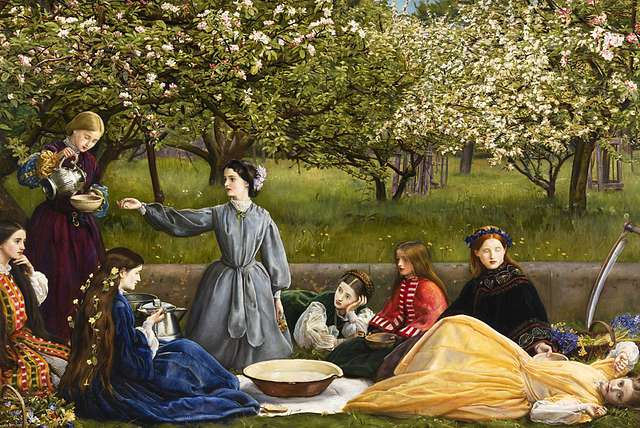
Spring (Apple Blossoms) (c.1856 - 1859), John Everett Millais
この作品には、英語ガイドの記事はありません。その代わりに、こうした絵画を読み解き、また自然をより豊かに描写するために役立つ17の語彙と9つの文法ノートを用意しました。見えているものを捉えるための語(orchard, foreground)、どのように見えるかを述べるための語(luminous, idyllic)、そして何を示唆しているのかを考えるための語(transience, mortality)です。
同時に、これは構文の感覚を磨く機会でもあります。In the foreground…, The figure appears…, The scene suggests…, While the image feels idyllic, it also…。こうした小さな型を使うことで、観察から解釈へと、英語を無理なく、しかも的確に進めていくことができます。
また、この場面に織り込まれた象徴性にも目を向けてみてください。これは、たとえばモネの風景画について語るときのように、「葉のあいだから差し込む光」といった印象だけで始まり、そこで終わるような種類の絵ではありません。ここでは、花は若さを指し示しているかもしれませんし、身ぶりや視線といったごくささやかな要素でさえ、無常や死すべきものとしての人のあり方をほのめかしている可能性があります。
さらにこのテーマを深めるために、信頼できる英語の使われ方に触れられるよう、選び抜いた native materials も用意しました。ここで語彙に取り組んだあと、それらの資料へと進み、記述・構文・解釈が実際の文脈の中でどのように結びついているかを見てみてください。
次のステップ
全文・音声・語彙解説・文法ポイント・クイズ・スラッシュリーディングは、
すべて会員向けコンテンツとしてご覧いただけます。
Author