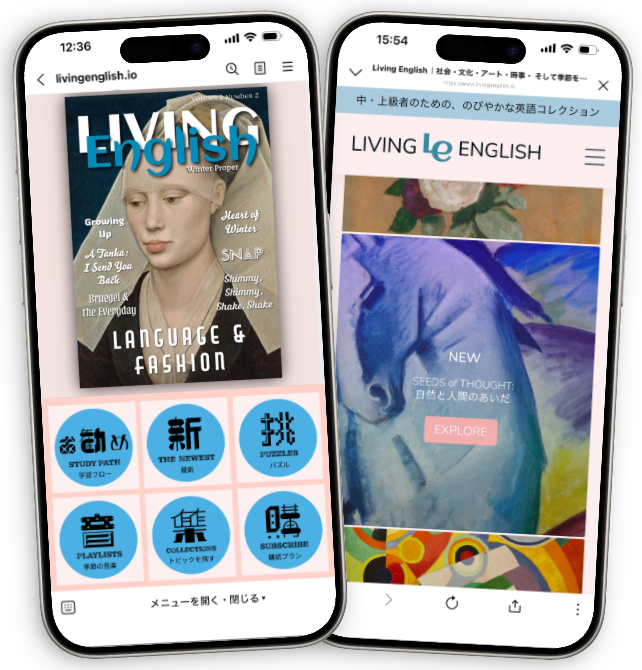
Living English の考え方・使い方
The Living English Principle
Click Here for the Original English
Language is a tool. Not an end.
One of my greatest frustrations teaching English was seeing English reduced to tests, classrooms, and carefully managed study spaces. Endless explanations in Japanese about simple English phrases and grammar points. What I call the “studying English in Japanese” movement. Programs and books that endlessly explain English rather than help people actually handle it.
Many people begin to feel that English belongs to special classrooms, teachers, cafes, or study time — not to ordinary life or personal reflection.
I understand why this happens. In Japan, most people do not truly need English in daily life. Outside of work emails, travel, or hobby study, there are few natural communal spaces for using it. And now, in the age of AI and automatic translation, the practical necessity seems even smaller.
So then: why continue with English at all?
Living English begins from a different assumption.
If English is not simply a survival tool, then it can become something more personal: a way to encounter ideas, seasons, art, music, history, and the wider world. The goal is not simply fluency or classroom performance. The goal is to build your English sensibility — your English mind.
Because conversation does not begin with grammar. It begins with thought. If you have nothing to say, speaking becomes very difficult.
The language guides here are meant to present English not simply as phrases or vocabulary lists, but as part of life, season, and reflection. They are meant to become stimulus for your own curiosity, reflection, and thought process.
To use the service well, I strongly encourage journalling.
Use a notebook, looseleaf paper, SNS, voice memos — whatever feels natural to you. Comment on the guides. Build from the guides. Follow the grammar points and the Use It or Lose It sections and actively apply the language in your own thinking and communication.
More importantly:
Use English, but live your life in Japanese.
That is one of the most valuable aspects of English today. Vast portions of the internet, writing, research, art, and discussion exist in English. English becomes a way to encounter ideas that you can then carry back into your own life, interests, and reflections in Japanese.
That is where the Native Links come in.
Finding meaningful material online is difficult. Finding reliable and engaging English material is even harder. The Native Links section is carefully selected to help bridge from the study guides into the wider world of real English.
The Study Portal is there to support you with more structured practice. The vocabulary and expressions in these guides are often challenging — frequently beyond pre-1 level — and the portal exists to help you gradually handle and internalize them through repeated exposure and use.
To use this service well, regular participation matters.
Find themes that genuinely interest you. Build some kind of journal system — physical or digital. Mine personally is very loose: looseleaf paper in a desk drawer, usually written with fountain pen or brush pen. I like the freedom of it.
But most importantly: engage with the material actively. Not only the articles and vocabulary, but also the Native Links and the Use It or Lose It sections. The goal is to move English from passive recognition into part of your everyday thinking.
Build the English mind.
Living English is meant to be stimulus for living with English — beyond purely functional language.
And if articles are not your preferred path, explore the Seeds of Thought. These are collections of activities, links, videos, and themes connected to the season or topic, but freer and less study-focused in structure.
Should you ever need help, the Bespoke Me coaching service is also available. It exists to help you manage the materials more effectively and develop your English facility in a way suited to your own interests and goals.
The general ideas and themes of Living English are available to all. But the full Study Portal, word lists, Native Links selections, and Bespoke Me services are available only to subscribers.
Wishing you the very best in rich, authentic English.
May livingenglish.io become a meaningful companion along the way.
— Derek
Q: Why don’t you show your face and make videos?
It would certainly be easy to build the project around personality and visibility. But my greatest fear is creating a community based more on a person than on the ideas themselves.
Living English functions as a service: something that helps people encounter rich, inspiring ideas through the prism of English and apply them meaningfully in their own lives.
So I try to present just enough of myself for you to know there is a real native-speaking human behind the wheel — but not so much that the personality overtakes the mission.
Language is a tool. Not an end.
言語は道具です。目的そのものではありません。
私が英語を教える中で、ずっと感じていた違和感があります。
英語が、テストや教室、あるいは「勉強の時間」の中だけに閉じ込められてしまうことです。簡単な表現や文法事項を、日本語で延々と説明する。私が「日本語で英語を勉強する運動」と呼んでいるものです。英語を実際に扱う力よりも、「英語について説明すること」に重点が置かれている。
すると、英語がどこか不自然なものになっていきます。
英語は、教室や先生、英会話カフェ、勉強時間の中にあるもの。日常や、自分自身の思考や感覚とは切り離されたもの。そんな感覚を持つ人も少なくありません。
でも、それには理由があります。
日本では、多くの人にとって英語は生活必需品ではありません。仕事のメール、旅行、趣味としての学習を除けば、英語を自然に使う共同体はそれほど多くない。そして今はAI翻訳もどんどん進化しています。実用面だけを考えれば、「なぜ英語を続けるのか」という疑問はむしろ自然です。
では、それでもなぜ英語を学ぶのか。
Living English は、
そこを別の角度から考えます。
英語を単なる「必要なスキル」としてではなく、季節や芸術、音楽、歴史、世界の出来事と出会うための窓として捉える。流暢さや授業的な正解だけを目指すのではなく、自分自身の「英語の感覚」── English Mind を育てていく。
なぜなら、会話は文法から始まるわけではないからです。
まず思考がある。感じることや、考えることがある。言いたいことが何もなければ、人はなかなか話せません。
Living English のガイドは、単なる単語帳や表現集ではありません。
季節や社会、芸術や世界とのつながりの中で、英語を扱っていくためのものです。そして、その言葉があなた自身の思考や好奇心、内面の刺激になっていくことを願っています。
このサービスを活かす上で、私が強く勧めたいのが journalling です。
ノートでも、ルーズリーフでも、SNSでも、音声メモでも構いません。自分に自然な形で、言葉を扱ってみてください。ガイドに反応する。言葉を書き留める。Use It or Lose It の内容を、自分の思考や日常に応用してみる。
そして何より大切なのは、
「英語を使いながら、
日本語で生きること」です。
これは現代の英語の大きな価値の一つだと思っています。
インターネット上の膨大な情報、研究、芸術、議論は英語で存在しています。英語は、「英語圏の人間になるため」のものではなく、新しい刺激や視点に出会い、それを日本語の人生へ持ち帰るための窓にもなります。
Native Links は、そのためにあります。
世の中には情報が溢れています。でも、本当に良い素材や、深く入っていける英語コンテンツを探すのは簡単ではありません。Native Links は、Study Guide から実際の英語世界へ橋を架けるために、私自身が選び抜いているものです。
Study Portal は、より構造的な練習のために用意しています。
このガイドで扱う単語や表現は、時にかなり難しいものもあります。準1級を超えるものも少なくありません。Portal は、それらを繰り返し触れながら、自分の中へ少しずつ定着させていくための場所です。
このサービスは、定期的に触れることで意味が深まります。
自分が本当に興味を持てるテーマを見つけること。そして、自分なりの journal の形を持つこと。ちなみに私はかなり雑です。机の引き出しにルーズリーフを入れて、万年筆や筆ペンで思いついたことを書いています。その自由さが好きです。
でも何より大切なのは、「受け身で終わらせないこと」です。
記事や単語を見るだけではなく、Native Links や Use It or Lose It を通して、自分の思考の中で実際に英語を動かしていく。
Build the English Mind.
Living English は、「機能としての英語」だけではなく、英語と共に生きるための刺激でありたいと思っています。
もし記事中心の学習が合わなければ、Seeds of Thought を覗いてみてください。テーマに関連した動画、活動、リンクなどを、もっと自由な形でまとめたものです。
また、必要であれば Bespoke Me のコーチングサービスも利用できます。自分に合った形で教材を扱い、英語の感覚を深めていくためのお手伝いです。
Living English のテーマや考え方そのものは、誰でも触れられるようにしています。ただし、Study Portal、本編の単語リスト、Native Links の選定、そして Bespoke Me のサービスは、登録メンバー向けの内容になります。
豊かで、本物の英語との出会いを願っています。
Living English が、その道のりの良い伴走者になれば幸いです。
— Derek
Q:なぜ顔を出して動画を作らないのですか?
もちろん、その方が簡単な部分もあります。ですが、私が一番避けたいのは、「人」への意識が、サービスの目的そのものを上回ってしまうことです。
Living English は、英語というプリズムを通して、面白く、豊かなアイデアと出会い、それを自分の人生へ持ち帰るためのサービスとして作っています。
だから私は、「ネイティブの人間がちゃんと後ろにいる」と分かる程度には姿を見せつつも、あくまで主役はコンテンツと体験そのものでありたいと思っています。
次のステップ
Study Portal・語彙解説・Native Links・Use It or Lose It・Seeds of Thought は、
会員向けコンテンツとしてご覧いただけます。